"Championship course" is a catch-penny label used by resort developers and signifies only that the course in question is a dreary slog of over 7,000 yards for anyone foolish enough to play it off the back tees. PETER DOBEREINER
I had to chuckle at the headline of Rex Hoggard's story on Tiger's third round 66 in Abu Dhabi: "Woods on the verge of ending victory drought." I know the Chevron World Challenge was only an 18 player field, but technically a win is a win, no?
Anyway, Hoggard writes:
Left unsaid was whether Woods’ aura would be worth a half stroke per side the way some believe it used to.
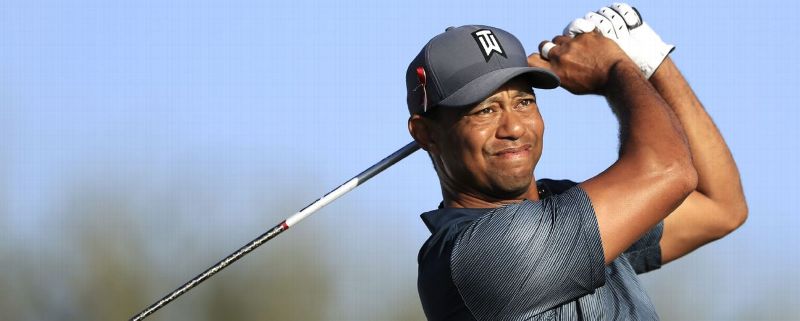
Tiger 3.0 may not inspire angina the way the old model did, but all eyes were on Woods on Saturday. His third-round 66 was his second bogey-free effort this week and moved him into a tie for the lead with Robert Rock and two-strokes clear of all others.
For close observers, Saturday’s 66 may be his biggest accomplishment of the week. Day 3 was the ultimate litmus test for Woods, who ranked 176th in Round 3 scoring on the PGA Tour last year and in November was sent spiraling down the leaderboard by a third-round 75 at the Australian Open.
In short, Saturday’s have been anything but special for the one-time Round 3 specialist.
The way I play, 18 holes is long enough. Apps that prolong it and then remind me of my failures are App-torturous and should be illegal. Yet we would have to reverse the profit motive in one of America’s most lucrative and ascendant for-profit industries to stop the intrusion of Apps and STU phones on the course. There is probably no handicap that can equalize my chances of avoiding these consequences.
As of early December, 2011, we crossed the threshold of having over one million Apps. The techno golf era is stalking the fairways. Nothing I see is sending it back to the clubhouse until every player is solicited with Apps for the swing, the strategy, the shot, the statistics, the co-golfer comparisons, and other score-dropping calculations from your STU phone. Don’t expect the golf courses to ban STU phones. If billion-dollar football and basketball industries cannot resist the advertising revenues, why would a struggling golf course industry? Will you resist? See you at the “How to Correct your Slice” App.
I blogged too soon...various media outlets have gotten the golf and socializing out of their system and have filed some 21st-century style (video!) reports from the PGA Show.
Jim Frank reports on various floor items spotted, including the new True Linkswear shoes that look even better than generation one, which remain the most comfortable I've ever worn.
Also had a chance to chat with short game master Dave Pelz, who said that a majority of people should switch to the belly putter. He thinks it’s easier for them and more effective.
"I wasn't thinking clearly and just made a very stupid mental mistake," McIlroy said following a level-par 72 that left him tied for fourth on five-under-par and part of a group which also included Tiger Woods. Asked if he did not know the rule or just had a loss of concentration, he added: "I think it was a little bit of both - first week back as well. "Luke said: 'Don't think you can do that', and I was like: 'Oh yeah, I can't, can I?'.
"It happens and you just have to take it on the chin. "There was so much sand in my line I didn't even think about it. I'll definitely not do it again." McIlroy certainly did not blame Donald for pointing it out and remembered what happened to Padraig Harrington in the same event last year.
I've watched the telecast and you don't see him actually violate the rule, instead just asking his playing partners if he'd erred. No YouTube video coming...so he's got that going for him.
"Ideally what you'd want," said one of the contending architects, "is a course that would deliver the kind of thrilling finale that Augusta National traditionally serves up at the Masters." That is, two or three competitors under knee-buckling pressure battling on the last few holes.
This person didn't want to be named; contenders were required by Rio 2016, the host city's organizing committee, to sign nondisclosure agreements. Mr. Doak, speaking more generally about the competition, said via email, "It's a rare chance to define (or redefine) what a great championship course is supposed to be, on a very big stage."
“I don’t know who my assistant captains will be yet,” Mallon said. “But I do believe Dottie Pepper should be a captain someday. I also strongly believe that anyone who is captain should be an assistant captain first. Whether it’s me who names her, or another captain after me, Dottie was the face of the U.S. Solheim Cup team in the ‘90s. She deserves to be captain.”
Mallon believes it’s time to welcome Pepper back into the Solheim Cup fold.
“I’m all about forgiveness, and I think both sides need to step forward to kind of have that healing happen, and it couldn’t happen soon enough for me,” Mallon said. “I’ve spent my whole career with Dottie, and I know her whole heart bleeds red, white and blue. She is so passionate about the Solheim Cup that sometimes that passion comes out in ways that have obviously hurt other people. But I still believe you can get over those hurts, and that she will be a captain someday.”
Pepper, 46, was visibly moved when told about Mallon’s comment.
“I don’t know what to make of it, but it’s terribly complimentary, and that means a lot to me,” Pepper told GolfChannel.com.
Update on Friday, January 27, 2012 at 06:28 PM by
Geoff
The PGA of America's State of the Industry Roundtable at the PGA Show is an annual gathering of bluecoats talking up the great state of the game and their latest initiatives. Thursday appears to have been no different as they unveiled the 2012 intiative, Golf 2.0, complete with a Boy and Girls Scouts component.
I don't usually make a point to pick on Tee it Forward, the 2011 program lauded by the panel in the parts of the incomplete (why?) transcript, but as you read them proudly discuss how moving tees forward made golf more fun for those who tried, you want to ask: then why is it you are opposed to rolling back distance to help us condense our bloated courses?
Anyway, a few highlights from PGA President Allen Wronowski's lengthy opening remarks, starting with his assessment that parking issues at the convention center would indicate a rebounding industry: "We are getting discussions about the parking situation, which is a great challenge to have."
-The growth mantra came up repeatedly, even though growth is not the problem. People playing less or not at all is, so they've got Golf 2.0 to the rescue. The initiative is anchored by three pillars leaning on the PGA Professional. "A lot of the components of those pillars and the 12 initiatives, we know that education of our membership is extremely important. You are going to see a lot of education programs that we'll devote to it.
-In introducing Jack Nicklaus, Wronowski could have probably left out the last Jack anecdote:
I am very proud that one of the first people to do that was Jack Nicklaus. Just as a reminder, they gave me these in front of me: 18 career majors, a record five PGA Championships which tied with Walter Hagen; five‑time PGA Player of the Year. He played on six U.S. Ryder Cup teams. He's been captain of The Ryder Cup Team twice. He's a member of the world golf and PGA golf professional Hall of Fame. He's the owner of the Nicklaus Companies and he's a golf course designer, architect, businessman, philanthropist and he is currently leading the revitalization of our own Valhalla Golf Club.
Yes, a second revitalization! What a world.
As for Nicklaus, he talked about how his Captain's Club at Muirfield Village attempted to influence the leading organizations a few years ago and got the blow-off. Classy!
What do we do about the game of golf. And they put together a position letter, which was sent out to the USGA and sent out to The PGA and so forth, and this was a couple years ago. That didn't get very far. It was sort of, what are these old fellows doing; what do they think they are talking about.
He did a nice job talking about the lost relatability of the pro game, though he also says no change needs to be made to the pro game?!
Tournament golf, we don't want to change. We don't want to change it. Tournament golf is terrific. I love watching these guys pop it out there and make a lot of putts and do all that kind of stuff. But somebody else, it used to be 30 years ago, I could play with the club champion at a golf course and he had a good chance of beating me. Playing basically the same game. Playing a golf ball that didn't go very far. We were playing tees that maybe were ten or 15 yards apart and I might out‑drive him by 20 yards. But it wasn't a big deal, and he knew the course and he might beat me.
Today, can you imagine a club champion going out and playing a 7,500‑yard golf course and playing Tiger or Phil and beating them? Not a chance in this world. The game has changed. The game has gone beyond being able to relate back to the people relating to our pros and that's a same. We've lost that and we need to bring that back. I'm not saying ‑‑ everybody thinks the game they played was the best game. The game I played was a good game but the game they play today is still a good game, too.
It's different. And relating to the golfer is tougher. We want these guys to be our heros and these gals to be our heros. We want them to be ‑‑ we want to relate to them.
PGA of America CEO Joe Steranka spoke next about what the focus groups have been telling them. He didn't mention the unwatchable PGA Championship telecast, but he did get lots of positive reinforcement about "the product."
The great news is, this study that you saw some of the qualitative focus groups and quantitative analysis, as well, and it validated that, hey, our product is pretty good.
Here was the one suggestion that everyone in the industry has to get involved.
We are saying in this reset of the economy and our lives, when time is just as much a precious commodity as household wages, no segment of the industry is immune from the change and no segment of the industry can stay on the sidelines or outside the ropes and not get involved in Golf 2.0.
Then he announced a new partnership with the American Society of Golf Course Architects that was by far the most promising item of the day and which could have actual benefits for struggling facilities. The PGA will be offering grants to cover the architect's costs to offer evaluations of how to re-think properties. That's right, the PGA's going to free up some of its millions.
75 years ago or so The PGA of America hired A.W. Tillinghast to be a free consultant to America's golf courses to guide them on how to make their courses more friendly after the Great Depression.
They had to introduce new players. They had to make the courses more friendly for women. Tillinghast wrote to them, the then PGA president, that he had deconsecrated 7,000 bunkers in his tour across America.
Our grant to their foundation is going to provide the travel expenses for architects who are going to volunteer to give free reviews of American golf courses and how to use the existing land plan. Maybe it's rerouting a hole to expand a range and add in three to six short holes that can be bunny slopes and bring that family out even more to the course.
And it was at this point that whoever was meddling with the transcript pretty much made it impossible to follow, though I'm sure the Q&A was entertaining.
At one point, the august group of golf dignitaries seated around the room at the PGA Merchandise Show began discussing making the size of the golf hole bigger to make the sport more enjoyable to millions.
U.S. Golf Association executive director Mike Davis noted that it will never happen at the U.S. Open, which his organization runs.
Interjected Jack Nicklaus: “Why not?”
The room broke up in laughter. We think he was kidding, but maybe the joke’s over. AT this point, perhaps the joking should stop.
That seems to be the new message -- hold the giggles.
Update on Thursday, January 26, 2012 at 10:10 PM by
Geoff
**Here's a Golfweek video with some of the comments from the event:
On the contrary, it creates more of a closed shop than ever. More likely than not, there will be no more than 25 “new” faces per year on PGA Tour cards, as opposed to the roughly 50 annually that graduate to the big leagues under the current system with Q school and the Nationwide sending at least 25 each. And perhaps only a handful of those “new” faces might be true rookies.
The players this system might affect the most are college All-Americans and international players. If a college stud doesn’t make enough money in his seven exemptions to earn a place in the qualifying series, he’ll have no chance to play his way onto the PGA Tour the following year.
And international players, who rarely get sponsor invites, will be less inclined to come to Q school to try to earn a one-year apprenticeship. Y.E. Yang wouldn’t have had the chance to graduate Q school one year and become the first Asian player to win a major the next.
“I think you still have to have a way to qualify,” Parel said. “Take some number from Q school. Even if it’s just five. You need to have some incentive at Q school other than getting Nationwide Tour status. I just don’t see that being fair.”
Thanks to reader Tim for monitoring SI's Tumblr feed and catching thismildly disturbing Stuart Franklin Getty image posted today of Dustin Johnson at the player party during the 2011 BMW International Open. I'm thinking his lower leg injury issues could date to trying to slip those pants on over his knee?
The image is part of a gallery that could be titled, Players Doing Whatever They Have To Do To Earn Their Appearance Fee.
Lawrence Donegan points out that Rory McIlroy didn't hit the ball as well as playing partners Tiger Woods and Luke Donald, yet managed and scrambled his way past the two veterans by several shots.
The Northern Irishman, grouped alongside Tiger Woods and Luke Donald for the first round of the Abu Dhabi Championship, emerged with a three-shot advantage over the former world No1 and a four-shot lead over the man currently sitting atop golf's totem pole. As for the tournament itself, McIlroy was tied for the lead with Sweden's Robert Karlsson after 18 holes.
"I didn't feel like I played that good, but I did well to manage my way around the course," McIlroy said after shooting a five-under-par 67. Woods signed for a round of 70, and Donald for a 71. Goodness knows what scoring the American and the Englishman might need to match the world No3 were they to run into him on a good day.
McIlroy, meanwhile, came off the course feeling as he had won the lottery.
“I didn’t feel like I played that good,” McIlroy said. “I definitely didn’t strike the ball as good as I have the last couple of weeks. I think it’s just because it’s your first competitive round of the season, card in your hand, you can get a little tentative or a little apprehensive. I was able to manage my way around the golf course and end up shooting 5 under. I’m very pleased.”
The two men spent a lot of time chatting during the round, and it was clearly obvious from watching them that McIlroy has taken a leaf out of Woods’ fitness book. The 22-year-old has filled out what was once a slender frame. He’s wider across the shoulders and his upper arms look as if he’s been doing some serious weights over the winter.
“I’ve been working hard in the gym. I really started working hard last year. I feel like I’ve got a lot stronger and it’s definitely helped my golf.
“I feel like my lower body has gotten a lot more stable and a lot stronger. That means you can put the club in a better position on the way down and you can do it more often, so you become a lot more consistent.”
And that's about all I could find on the PGA Show. If others have some links, let me know.
Now, I don't want to be cynical about the golf equipment industry or the PGA of America, but if you ever want to see just how miserably far behind the golf world is when it comes to marketing its consumables, taking advantage of social media/the Internet and getting people excited about buying stuff, the restricted and light coverage of PGA Show always amazes me.
It was only a couple of weeks ago that coverage of the Consumer Electronics Show was unavoidable. Yet golf actually makes it hard for customers to learn about the latest and greatest stuff when the brains of the stuff industry gather to debut their latest and greatest stuff. So bizarre.
Players were plenty chatty at Torrey Pines about the PGA Tour's controversial Q-School concept and the ones I spoke to all came away with a similar conclusion: they have more questions now than before, and their sense is that the tour isn't even entirely sure what the point of the initiative is. On the record, a couple of stars were asked about it when they visited the press center.
Q. How up to speed are you on the Q‑school Nationwide thing and what would your thoughts be on that?
PHIL MICKELSON: I don't know if I really have an opinion either way. I don't really see that as being the issue. I didn't know anything. I went to the meeting last night just to hear and listen to what's going on.
But I see something different. I don't see that being the issue. What I see being the issue is trying to start the new season in October. I think the only way to do that is to have Q‑school not be part of the TOUR. You can't have Q‑school in that one wee if you end the TOUR Championship and start the following year in that one week.
So it looks like to me they're wanting to have a non‑calendar year, which means you've got to change the Q‑school. You want to make the Asian tournaments FedExCup events, and I believe they're going to add another couple in the short term to try to have four or five in Asia.
I think all of that to make those events the Fall Series and the Asian events FedExCup tournaments, they have to alter the Q‑school, so that's what I see.
Q. Do you like the idea of starting the season in the fall?
PHIL MICKELSON: I don't have an opinion. I'm just telling you what I see. I think you always have to have change to have growth. So I'm sure there are some good things to it. I just don't know. I just listen to what I heard last night, and I see them talking about the Q‑school thing. My mind keeps going that it looks to me like they're trying to set it up to have an Asian swing, to have the Fall Series be bigger events. The only way to do that is that Q‑school‑‑ you couldn't have Q‑school after the season's already started for a couple of months.
Q. Your thoughts on the Q‑school and Nationwide proposal from last night?
GEOFF OGILVY: I don't know. I quite like the way it is now. But I quite liked the way the TOUR was before the FedExCup was, and I actually like the TOUR better now with the FedExCup. I thought it was ridiculous having the FedExCup, but now it happened and I'm like this is pretty good. Every year it's gotten better, and I really like it.
So the TOUR hasn't made that many missteps in the last 20 or 30 years. They've put in a lot of work and time and thought into this. It's probably going to end up the right thing to do. It's not really going to affect most guys who‑‑ the bunch of guys who stay on TOUR every year and play. It's not going to affect them too much.
It's going to be interesting to see how people get on to how they choose to get on the TOUR and is everyone going to have to do that stepping stone through the Nationwide Tour? Or is there realistically a way to get to those playoff events without doing all of that? And how the Europeans choose to‑‑ if less of them choose to come and play here because it might be more difficult for them too, I don't know.
But as I said, the TOUR has a history of making pretty sensible decisions about the big structure changes. So I'll probably just go with them and trust them on it.
The U.S. Golf Manufacturers Anti-Counterfeiting Working Group announced today that it seized more than 95,000 counterfeit golf products in 2011, nearly four times the amount seized in the previous year. The significant increase demonstrates the group's improved ability to cooperate with law enforcement agencies around the world to identify and eliminate counterfeit operations. In addition to raids and seizures, 2011 saw the group launch an educational website which provided visitors with information on how to avoid purchasing counterfeit clubs. The Golf Group also took considerable legal actions against counterfeiters in China and the U.S., including successfully securing a court order to shut down a number of websites allegedly selling counterfeit clubs.
"The Golf Group remains committed to shutting down as many counterfeit operations as it possibly can," said Don Reino, Vice President of Legal Operations for Cleveland Golf. "The Golf Group's cooperative efforts, in combination with the continued support of Chinese law enforcement agencies, allowed us to send an even stronger message to counterfeiters around the world last year."